

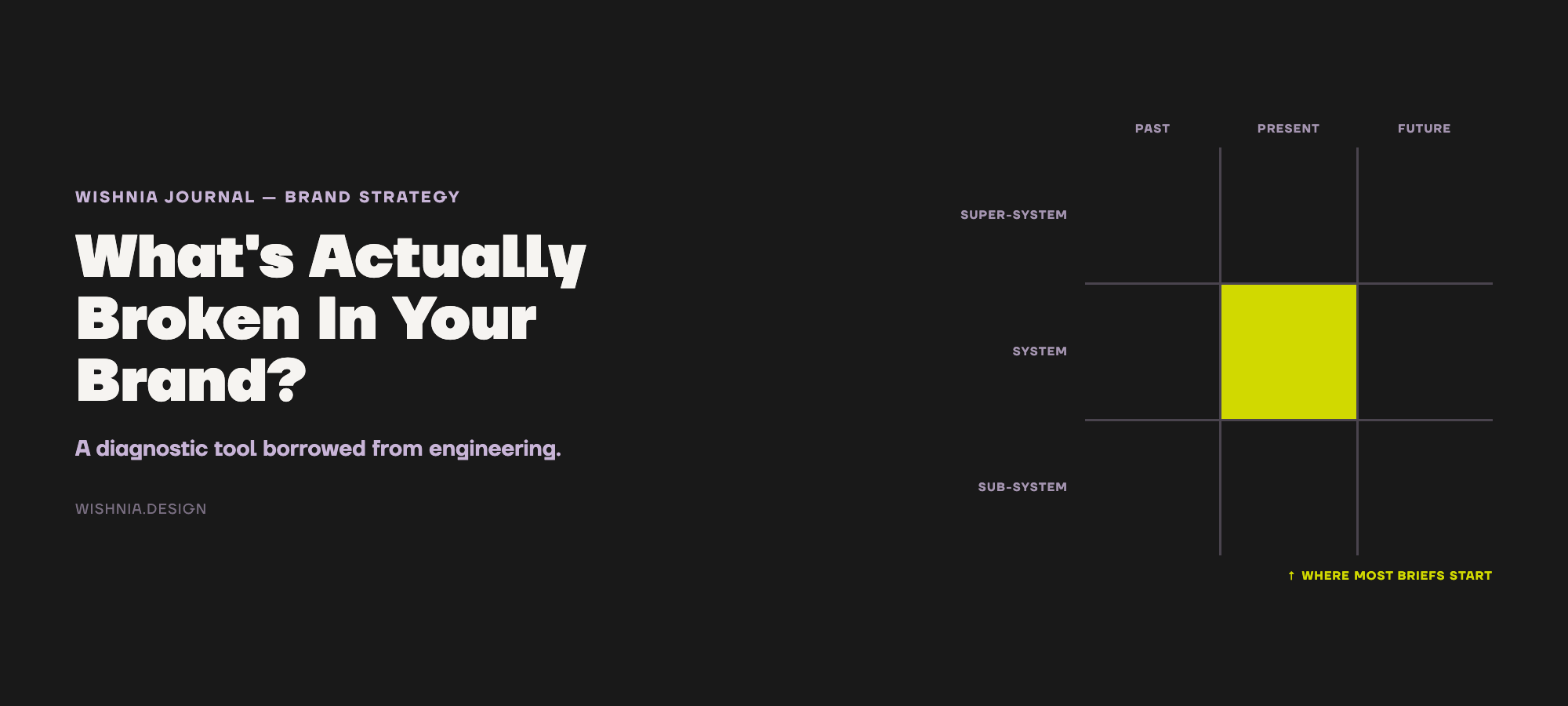
A tool borrowed from engineering
One of the most common scenarios in branding: a client arrives with a diagnosis already made. "We need a new logo." "The identity feels dated." "The website isn't converting." And the whole project ends up solving exactly that stated problem — even though the real issue often sits somewhere else entirely. There's a simple way to test a diagnosis before you start building a solution around it. It doesn't come from branding — it comes from engineering, and that's precisely what makes it useful: it won't let you look at an object only as it appears right now.
A TOOL NEVER MEANT FOR DESIGNERS
Inventor Genrich Altshuller was developing TRIZ — the Theory of Inventive Problem Solving. One of its tools is called the nine-screen method: a 3×3 grid where one axis is the system level (what's inside the object, the object itself, what surrounds it) and the other is time (past, present, future).The idea is simple. Ordinary thinking looks at a problem through a single screen — "the object as it looks right now." Altshuller proposed looking through nine screens at once, because the solution almost never lives where the symptom shows up.
attribution window
Not every touch that leads to a purchase sits close to that purchase in time. The attribution window is the period during which a touch still gets credit for the eventual decision. Set it to one day, and you'll only ever see the last click before purchase — everything that warmed the customer up weeks earlier stays invisible in your reports. Set it to a month, and you'll see the whole journey, but lose precision about what actually worked.
For coffee grabbed on the way to work, a short window is usually honest. For a brand spending years building recognition through packaging, collaborations and physical presence, the effect shows up over weeks — and judging that work by yesterday's click means writing off exactly what's bringing customers in, just more slowly than a dashboard likes.
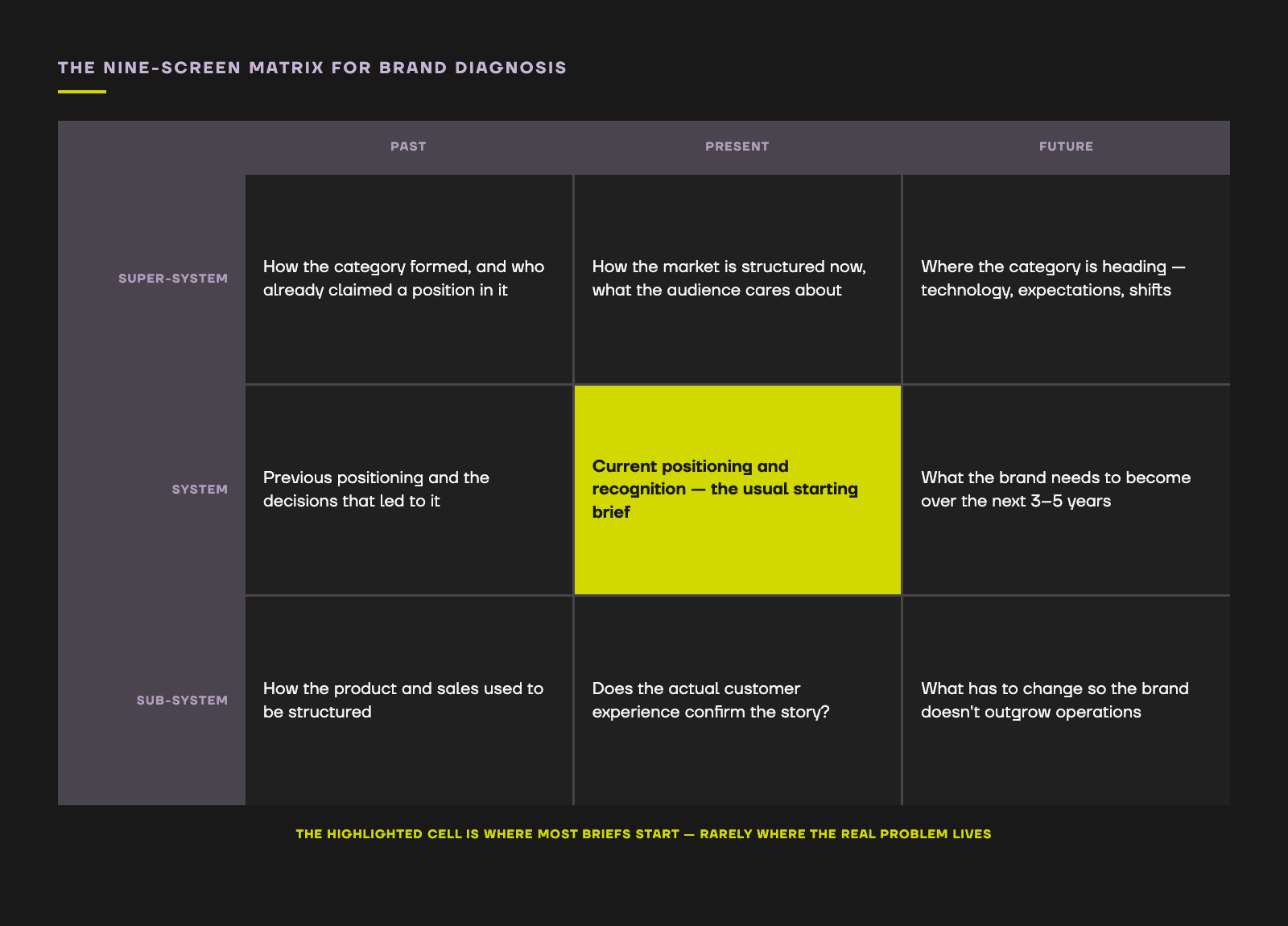
The center cell is usually what lands in the brief. The other eight are what the brief usually misses.
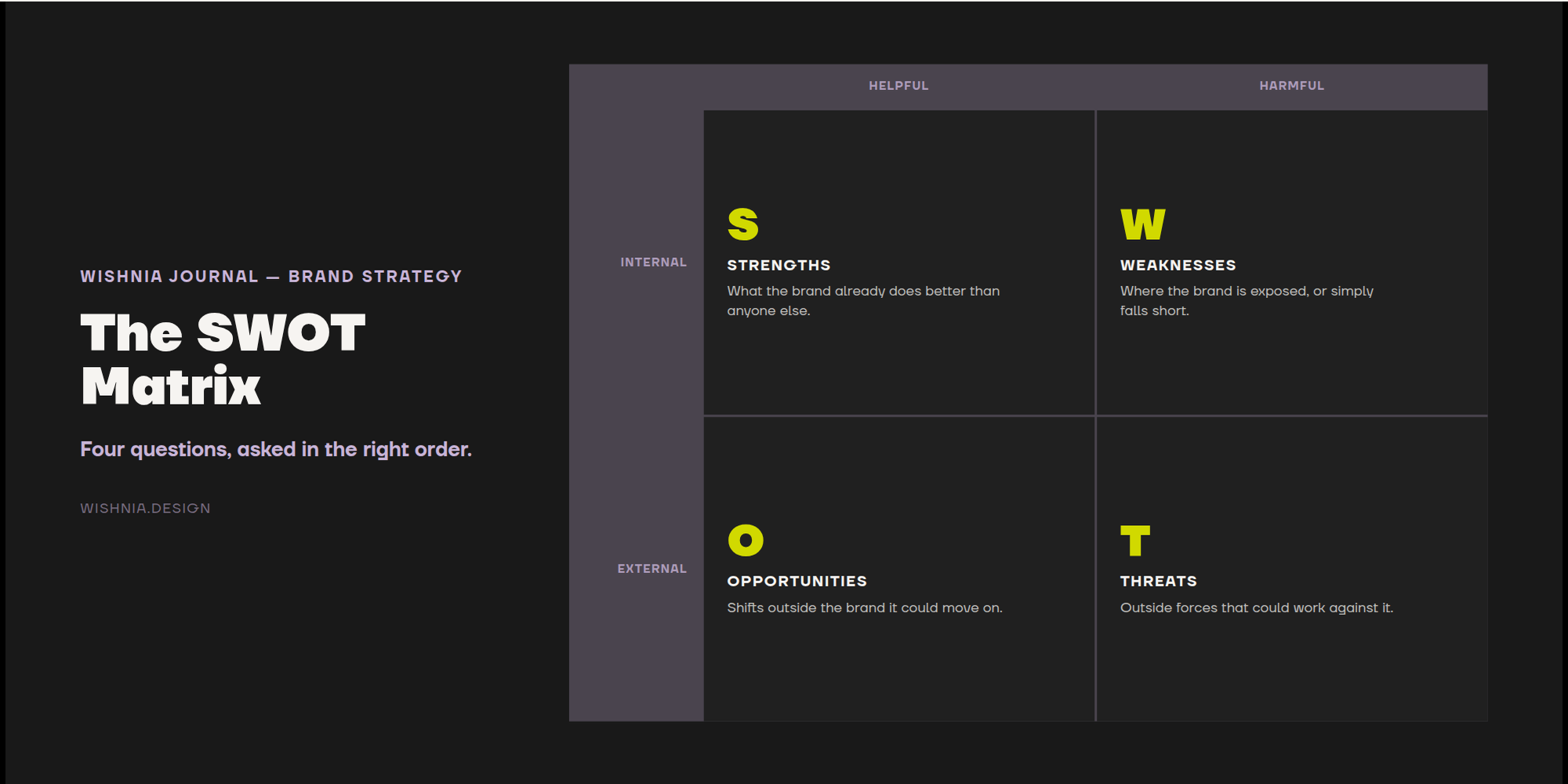
A SWOT analysis captures a state — strengths and weaknesses as they stand today. It's static. The nine-screen method adds what SWOT doesn't give you by default: explicit time dynamics. Not "what are our weaknesses," but where they came from and what happens to them if the market or the business doubles in size.
It also stops you from fixating on a single level. A problem framed as "we need a new logo" might actually live:
super-system
in the super-system — the market has shifted, and the old positioning no longer reads, so the issue is meaning, not form;
sub-system
in the sub-system — the product or service has moved on, and the identity hasn't caught up, so it's no longer saying what the brand actually is;
future
in the future — the brand was built for today's scale and won't hold up under growth that's already planned.
When I was building the MIRADEX brand — a supplier of metal fencing and façade systems in Bulgaria — this way of thinking, before I knew its formal name, effectively set the strategy.
Super-system, past
The fencing and façade market in the country was fragmented: many local manufacturers with no clear brand identity, and purchase decisions made on personal ties with a contractor and on price.
System, present
The brand we built competed on neither price nor connections, but on transparency and a digital channel — positioning and communication designed to generate warm leads directly, with no intermediaries.
Sub-system, present
This is where the real lever was — a referral program with a personal QR code for every partner, ambassador, and customer, with fully transparent order tracking and commission calculation. This isn't a marketing tool in the narrow sense. It's a mechanism that turns the promise of "transparency" into a verifiable fact instead of a claim on a website.
The result: roughly 60% market share in the core product category within two years, with every warm, sales-qualified lead coming through the digital system we built — not through the personal networks the category had traditionally run on.
Had the work started with "how do we make the logo feel more premium," that lever would have stayed invisible. It didn't live in the system — it lived in the sub-system, in how the processes and touchpoints were built, not in how the brand looked.
Before you settle on positioning or open a design file, walk through all nine cells — alone or with your team. It takes about an hour, and it usually surfaces mismatches that would otherwise only show up after launch: the brand claims one thing while the product or processes are saying another.
The question worth holding onto throughout: which cell does the problem you were handed as "we need a new logo" actually live in — and does it live there at all?
Not sure which cell your brand's problem is actually in? That's exactly the kind of question a brand audit is built to answer — get in touch to talk it through.