

One of the most persistent myths about creativity is that it simply arrives — through inspiration, and only if you happen to be talented. Either the idea shows up, or it doesn't, and there's nothing to be done about it either way. In practice, that's not how it works. Generating ideas is a skill, much like negotiation or time management, and it comes with a concrete set of tools. Below is a collection of methods that help both with producing unconventional ideas and with sorting through them for the ones actually worth pursuing.
One of the most persistent myths about creativity is that it simply arrives — through inspiration, and only if you happen to be talented. Either the idea shows up, or it doesn't, and there's nothing to be done about it either way. In practice, that's not how it works. Generating ideas is a skill, much like negotiation or time management, and it comes with a concrete set of tools. Below is a collection of methods that help both with producing unconventional ideas and with sorting through them for the ones actually worth pursuing.
The first tool comes from TRIZ — the Theory of Inventive Problem Solving — and is called the Ideal Final Result (IFR). The idea is to reformulate the question before searching for a solution: instead of asking "how do we solve this problem," you ask "what would the situation look like if the problem simply solved itself, at zero cost, in the most ideal way possible."
That reframing removes the usual constraints on thinking. Instead of "how do we make this process faster," IFR asks: "what if the process weren't needed at all, and the result happened on its own?" Once you've articulated that ideal — even a clearly unattainable one — it becomes much easier to identify realistic steps that move you toward it, because now you have a target to aim at instead of just a description of the problem.
The Six Thinking Hats method, developed by Edward de Bono, solves a different problem. It isn't primarily about generating ideas — it's about bringing order to discussions where everything usually gets tangled together: facts, emotions, criticism, and proposals all surface at once and interfere with each other.
White hat
facts and data only, no judgments
Red hat
emotions and gut reactions, no justification required
Black hat
criticism, risks, weak points
Yellow hat
benefits, upsides, an optimistic view
Green hat
free generation of new ideas.
Blue hat
managing the process and summarizing
When a team agrees "right now we're all wearing the black hat," criticism stops feeling like a personal attack on whoever proposed the idea — it's simply the stage the process is at. That sequencing saves time and defuses much of the friction typical of an unstructured brainstorm.
One of the most accessible ways to get unstuck is the association method. You take a random word, image, or object with no connection to the problem at hand, and deliberately search for links between it and whatever you're trying to come up with.
The mechanism is simple: the brain finds new combinations more easily when handed an unexpected "third element" than when it keeps circling the same problem on its own. A random word breaks the usual chains of thought and forces you to look for unlikely bridges between unrelated concepts — and it's precisely at the intersection of distant ideas that something genuinely original tends to emerge.
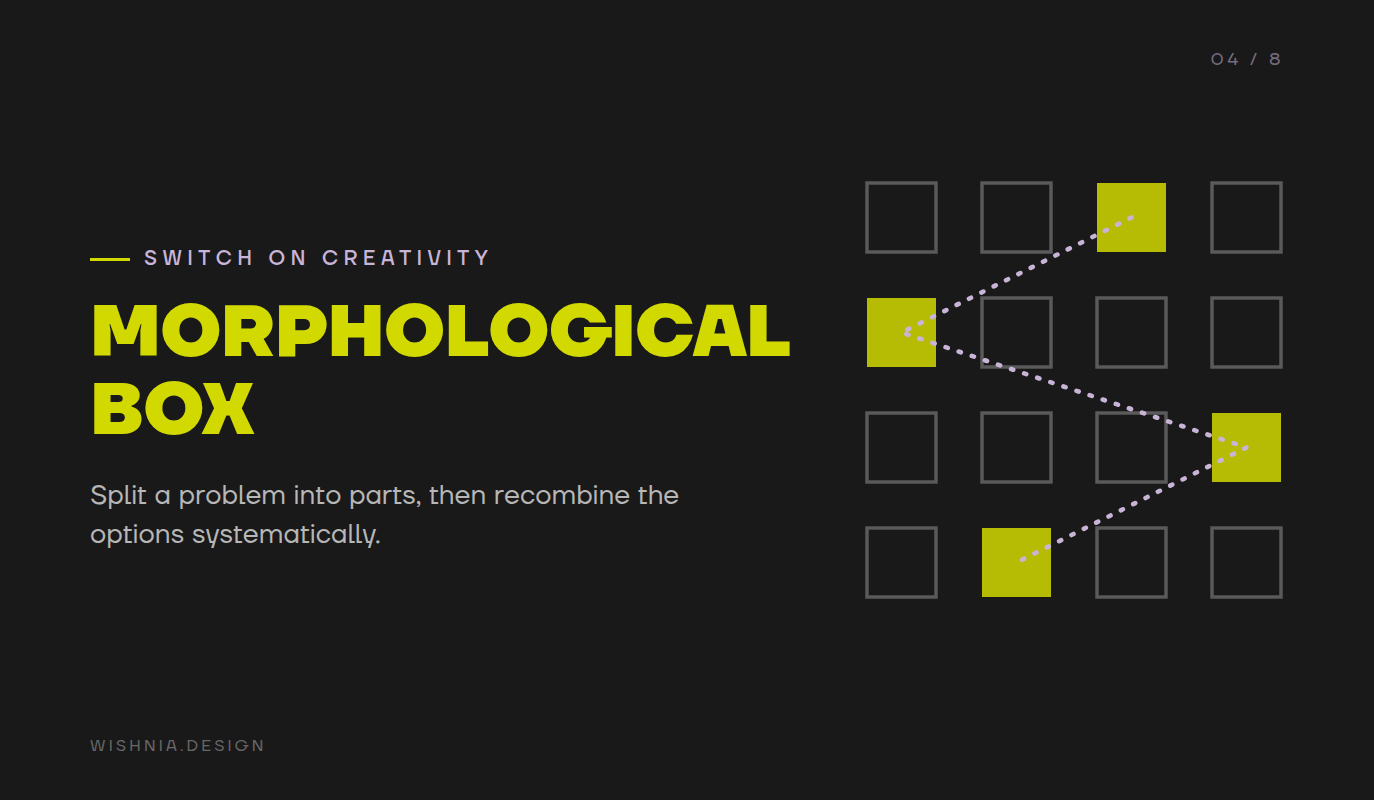
Also known as Zwicky's morphological box, this method is more systematic. The problem is broken down into independent parameters — for a new product, that might be shape, material, color, function, and audience — and a list of possible options is written out for each parameter.
Those options are then combined with each other, often randomly or through systematic enumeration, producing combinations that ordinary linear thinking would be unlikely to reach on its own. Not every combination will be a winner, but the method guarantees thoroughness: no possible variant is overlooked simply because it never came up during a regular brainstorm.
SCAMPER is a checklist of seven questions applied in sequence to an existing product, service, or process, in order to find a way to improve or reimagine it. The name is an acronym:
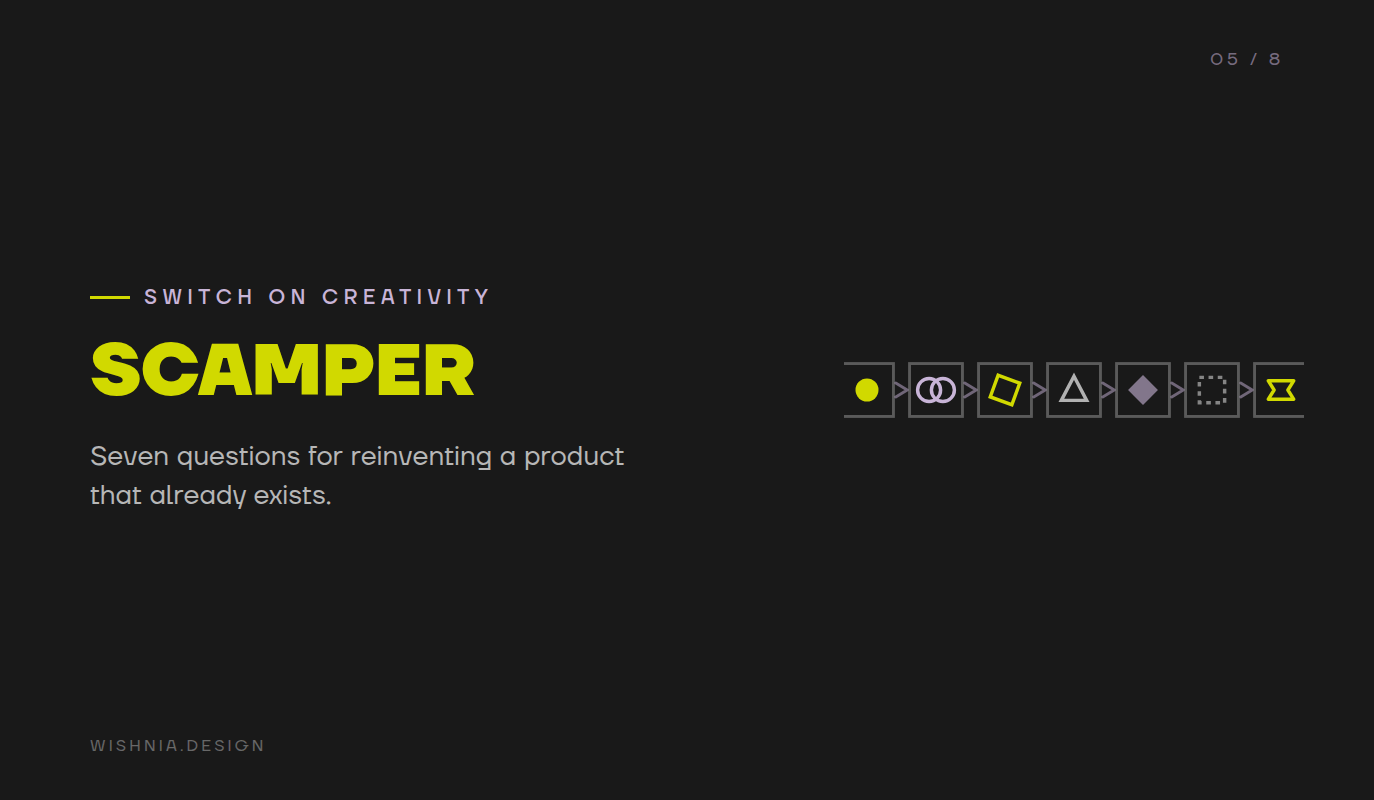
Substitute
what could be replaced: a material, a process, a person, a location?
Combine
what could this be combined with?
Adapt
what could be borrowed from another field and adapted here?
Modify
what could be enlarged, shrunk, intensified, or distorted?
Put to other use
how else could this be used?
Eliminate
what could be removed or simplified?
Reverse
what happens if the order is flipped, or it's done backwards?
SCAMPER's value is that it doesn't require inspiration — it's an operation you can run mechanically, working the product through each of the seven questions in turn. That kind of discipline is often exactly what's missing when "the brain is too tired to invent from scratch."
The "idea alarm clock" is less a formal technique than a principle: a way of capturing ideas the moment they appear, rather than waiting for a dedicated session to sit down and think. The best ideas often show up in the shower, on a walk, or in transit — precisely when the brain is relaxed and not consciously focused on the problem.
The practical takeaway is to always have a way to capture an idea quickly — a note on your phone, a notebook, a voice memo to yourself — rather than relying on memory. That turns stray flashes of insight into a working asset instead of thoughts that "happened and then got lost."
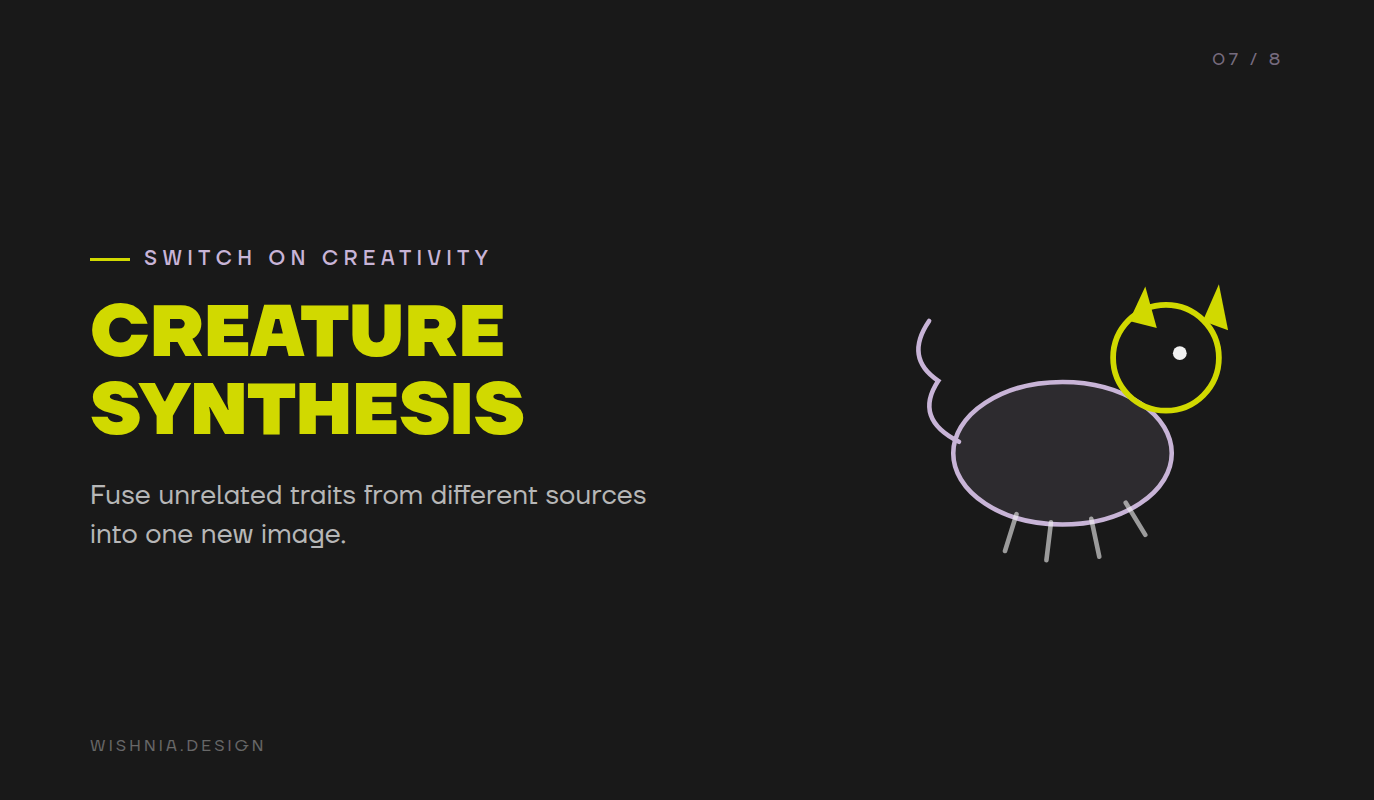
Another generative technique works by combining several random traits to build a new image or concept that didn't exist before. Individual characteristics — properties, body parts, materials, functions — are pulled from unrelated sources and fused into a single new object, creature, or idea.
The method is especially useful when you need a genuinely original visual or conceptual image: it forces the combination of elements that have never appeared together, functioning as a more visual, more literal version of the morphological box.
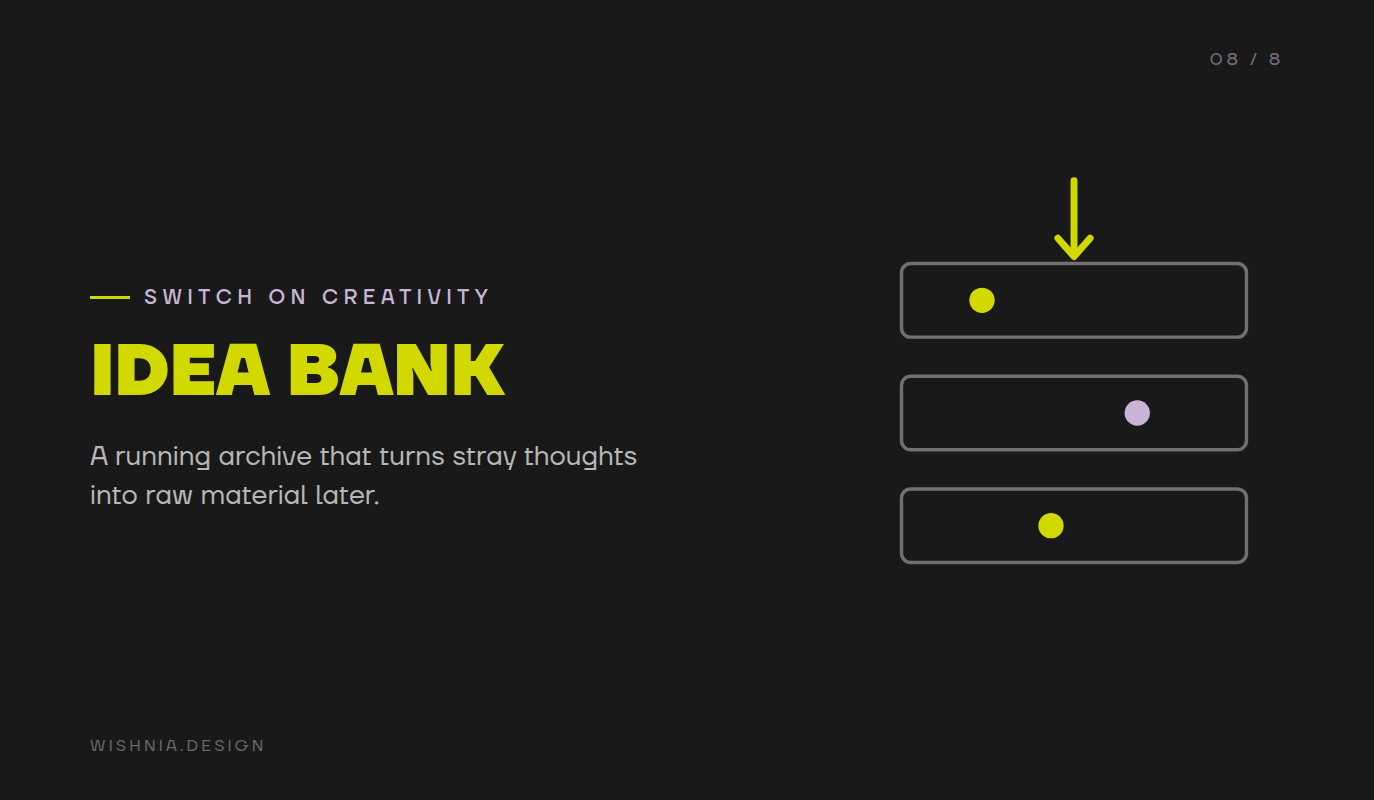
All of the techniques above lose much of their value if the ideas they generate are never saved and simply get forgotten between sessions. An "idea bank" is the habit of keeping a running archive: any thought, observation, interesting example from someone else's work, or random insight goes into one place — notes, a board, a spreadsheet — regardless of whether it seems useful right now.
Over time, that bank becomes a personal library of raw material. Instead of starting from a blank page every time, you can draw on what's already been collected and combine old finds with a new problem.
Generating ideas is only half the process. Once enough options have accumulated, the question becomes how to choose. A few simple checklists help here.
PMI — Plus / Minus / Interesting
Each idea is run through three columns: what's good about it, what's bad about it, and what's simply interesting and worth exploring further — even if it's not yet clear whether that's a plus or a minus. The method doesn't hand you a ready-made yes-or-no answer, but it also stops you from discarding an idea just because one obvious flaw jumps out immediately.
TESCO
A more structured checklist that scores an idea against several criteria at once — for example, technical feasibility, economic viability, strategic fit, audience fit, and originality (the exact criteria can be adapted to the task). This keeps an idea from being judged "by eye" on whichever single trait happens to stand out first.
"Measure Eight Times"
A list of eight checkpoint questions to ask before finalizing a decision: how realistic the idea is, whether the resources exist to execute it, who the audience is, what the risks are, what happens if it doesn't work, and so on. Essentially, it's the last check before an idea turns into a project.
The three tools solve different problems: PMI works well early on, when there are still many ideas and you don't want to filter too aggressively too soon; TESCO is for comparing a handful of strong finalists against objective criteria; "Measure Eight Times" is the final check immediately before execution begins.
The most practical part of all of this may be what to do when none of the methods are working and the ideas simply aren't there. A few principles that help:
Change your environment
The brain gets used to the context it usually thinks in, and starts to stall there. A change of scenery — a walk, a different café, even a different room — often breaks the block on its own.
Stop demanding the "perfect idea" on the first try
Giving yourself permission to come up with deliberately bad, silly, unworkable options relieves the pressure and, paradoxically, speeds up the arrival of good ones.
Set a time limit
A deadline — even an artificial one, like ten minutes to generate options — focuses attention far better than an open-ended invitation to "think it through properly."
Switch to another task and come back
The brain keeps processing a problem in the background even after conscious attention has moved elsewhere — the same mechanism behind ideas showing up in the shower.
Draw on your idea bank and your general exposure
The wider the base of what you've already seen, read, and tried, the more material there is for new combinations — creativity feeds on incoming information rather than appearing out of nothing.
It's worth keeping one overarching principle in mind: none of these methods substitute for genuine exposure and domain knowledge — they provide a structure that makes that knowledge easier to combine. A tool with no material to work on is useless, which is why regular reading, studying other people's work, and curiosity about adjacent fields remain just as much a part of the creative process as the techniques themselves.
Not every technique needs to be used at once. A workable sequence looks like this: define the Ideal Final Result for the problem to establish a target → pick one or two generative methods (association, SCAMPER, the morphological box) and produce a pool of ideas → run the strongest candidates through PMI or TESCO → make the final call using the "Measure Eight Times" checklist. In the background, keep feeding the idea bank continuously, and don't dismiss thoughts that arrive away from your desk.
Seen this way, creativity isn't a state you either have or don't — it's a process you can manage: gather material, apply structure to combine it, and deliberately select the result.
