Generating is easy now. Deciding what deserves to exist is not. The designer's job is quietly moving from making things to knowing which things are worth making — and that shift rewards exactly one ability.
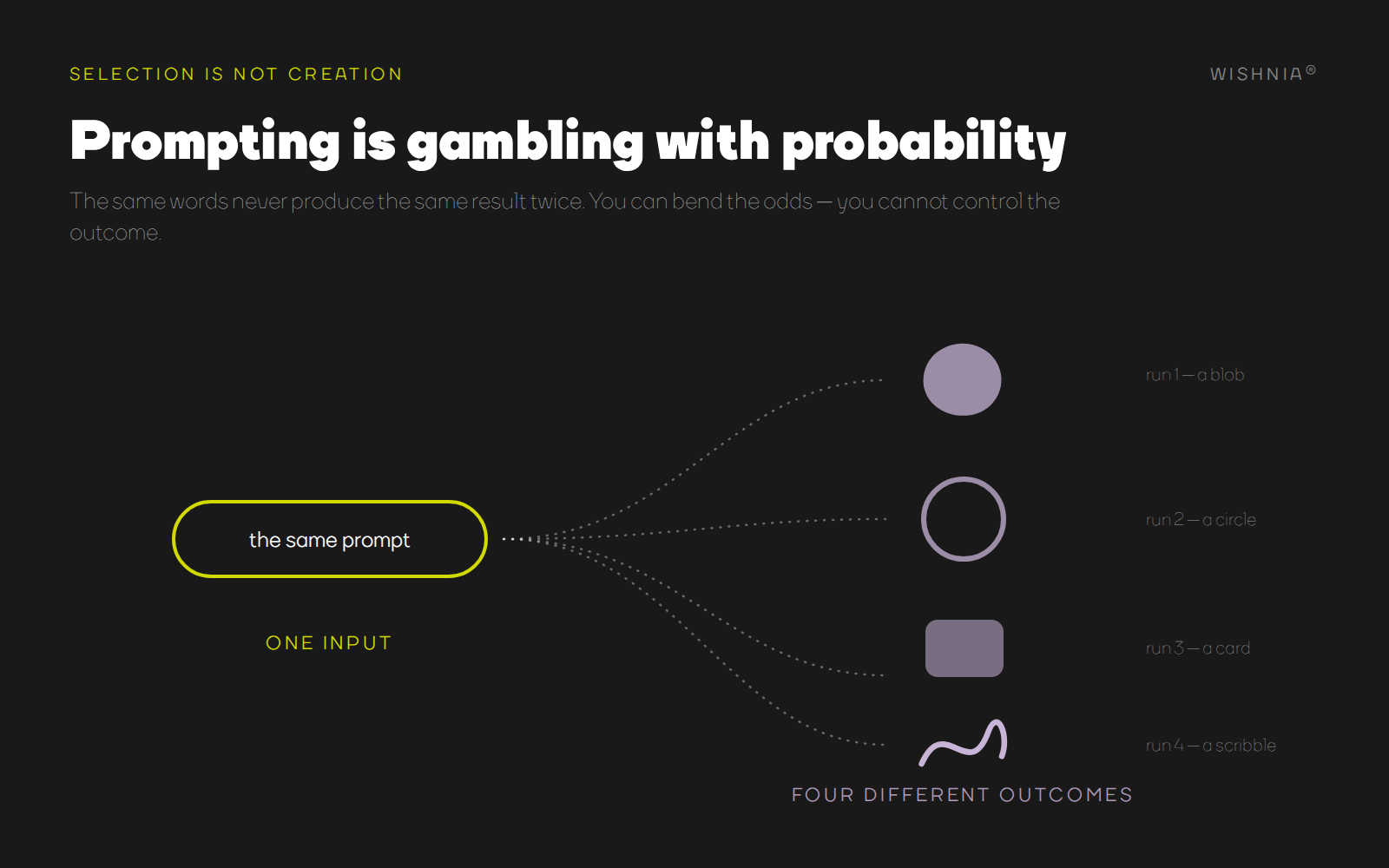
Ask an AI model whether prompting is a craft, and you will get a surprisingly honest answer: no. Run the same prompt twice and you get two different results. Prompting is not carving a form out of material with your own hands — it is gambling with probability. With enough skill and patience you can bend the odds by adjusting your words, but you are negotiating with a slot machine, not shaping an outcome. That distinction sounds philosophical. It is actually the most practical question in design right now.
The illusion of authorship
A new kind of designer is emerging: one who skips the craft stage entirely, never draws, never builds — and generates everything. There is nothing wrong with generating. The problem is the feeling that comes with it: I made this. You pressed a button. You wrote a sentence. Something appeared, and it looks finished, and the sense of authorship is real even when the authorship is not.The confusion is between selection and creation. When you create, you are in control of every decision — the tension between two elements, the weight of a line, the thing that is deliberately wrong because wrongness is what makes it alive. When you select, the model made those decisions, and you approved them. Approval is a real skill. But it is a different skill, and mistaking one for the other is how portfolios fill up with work that nobody, strictly speaking, designed.
The gravity of the average
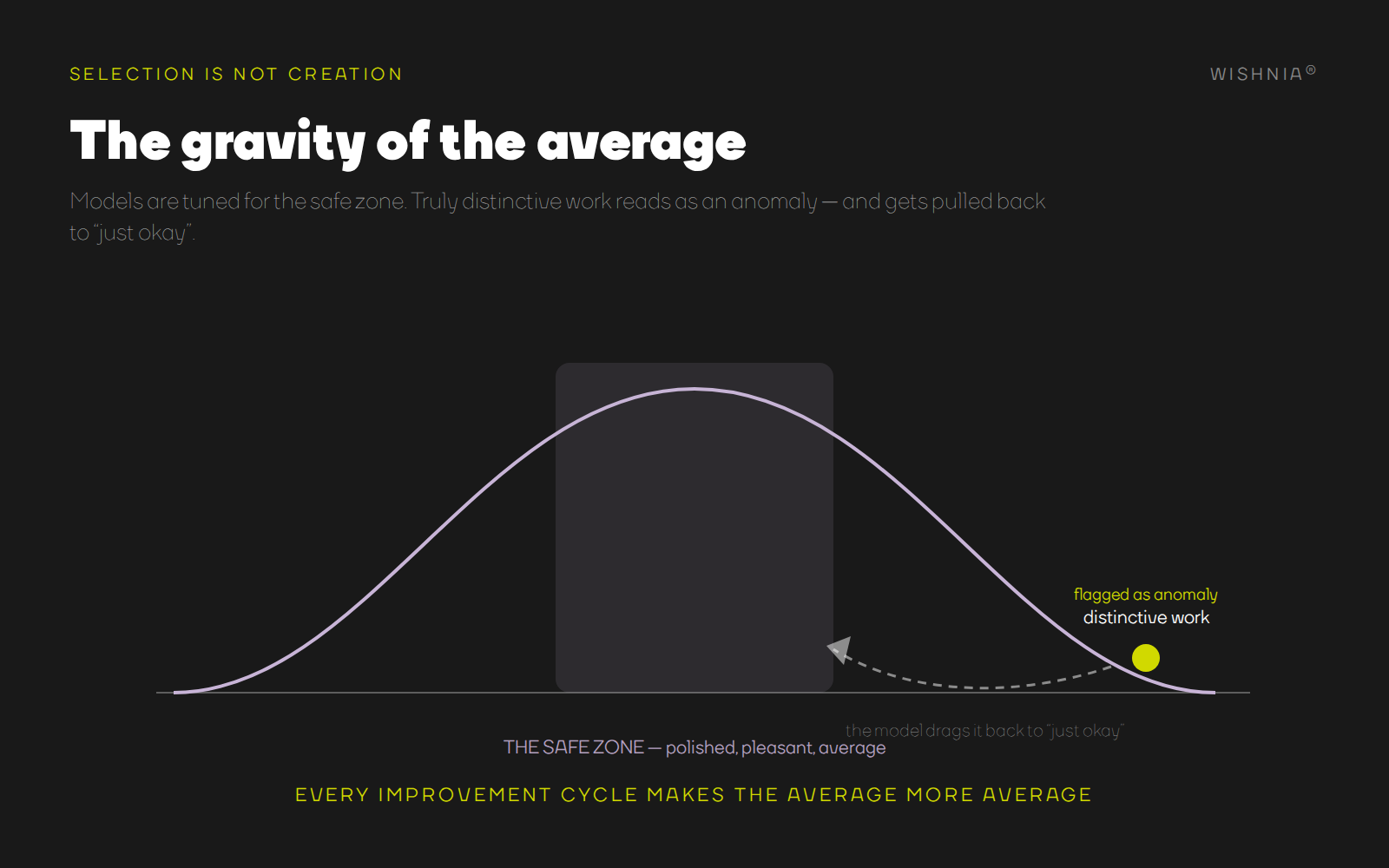
Why does it matter who made the decisions? Because of how the decision-maker was trained.A generative model is trained on everything we have already made, and tuned — deliberately, by teams whose job is to reduce failure — to produce results that are pleasant, safe, and broadly acceptable. Call it the safe zone. And here is the uncomfortable dynamic: every improvement cycle makes the safe zone safer. The models get better at being agreeable, which means their center of gravity drifts toward an ever more polished average.This creates what might be called the perfection problem. Truly distinctive work — the kind that defines a brand or an era — is, statistically speaking, an anomaly. It sits outside the distribution. And a system built to maximize acceptability treats anomalies the way an autocorrect treats an unusual word: as an error to be smoothed away. Try to push a model toward something genuinely strange and it will politely drag you back toward just okay. Not because it is broken, but because just okay is what it is optimized for.Great design has never lived at just okay. Taste requires friction. The work that matters is never the straight line; it is the deliberate deviation from it. Look at any product that defined its category: it was designed by people who trusted their own eye against every trend and every competitor on the shelf. The landscape around the early Apple was full of beige boxes made by very capable companies. The designers who broke from that did not do it by studying the average more carefully. They did it by refusing it.
Taste is a muscle, not a gift
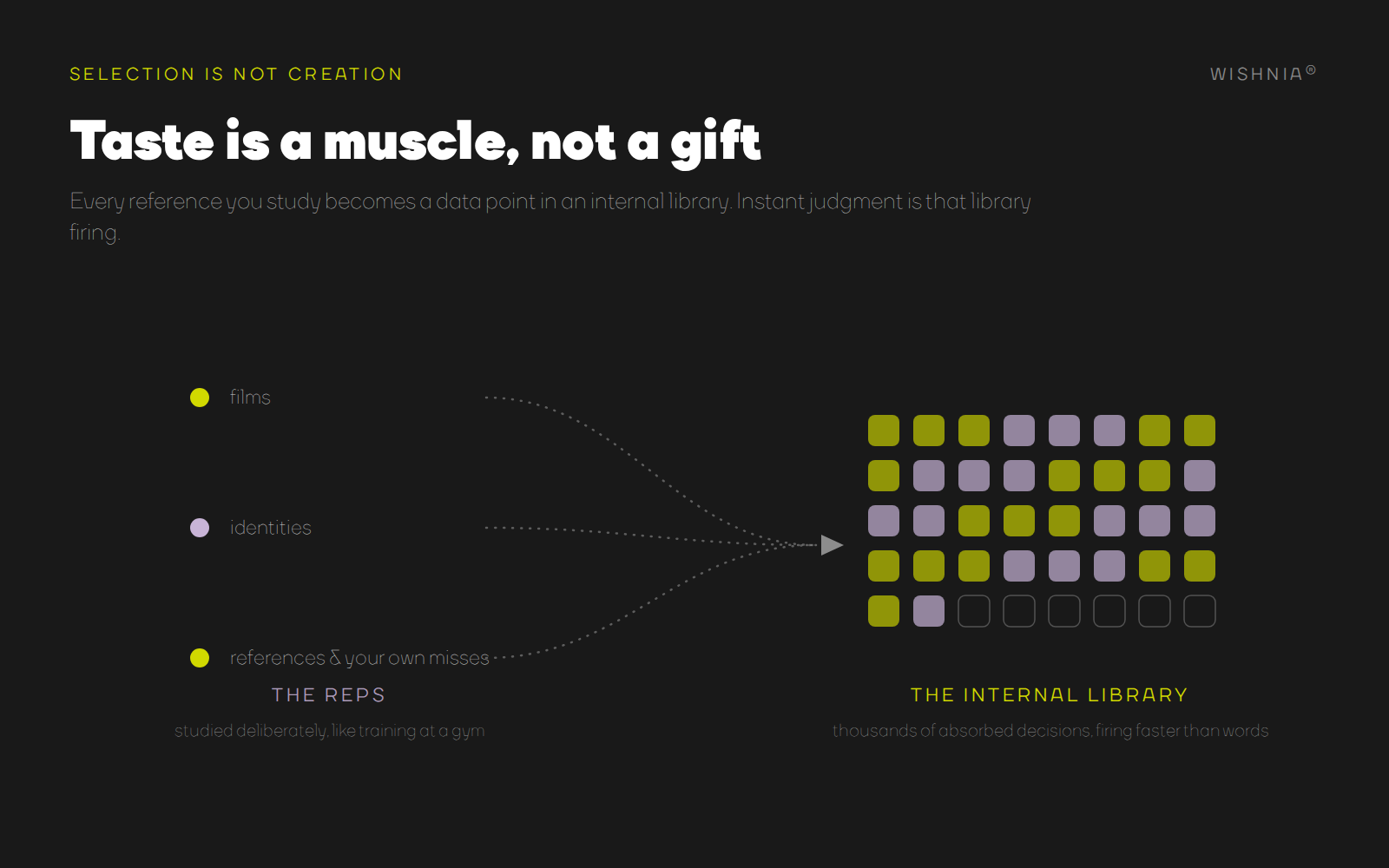
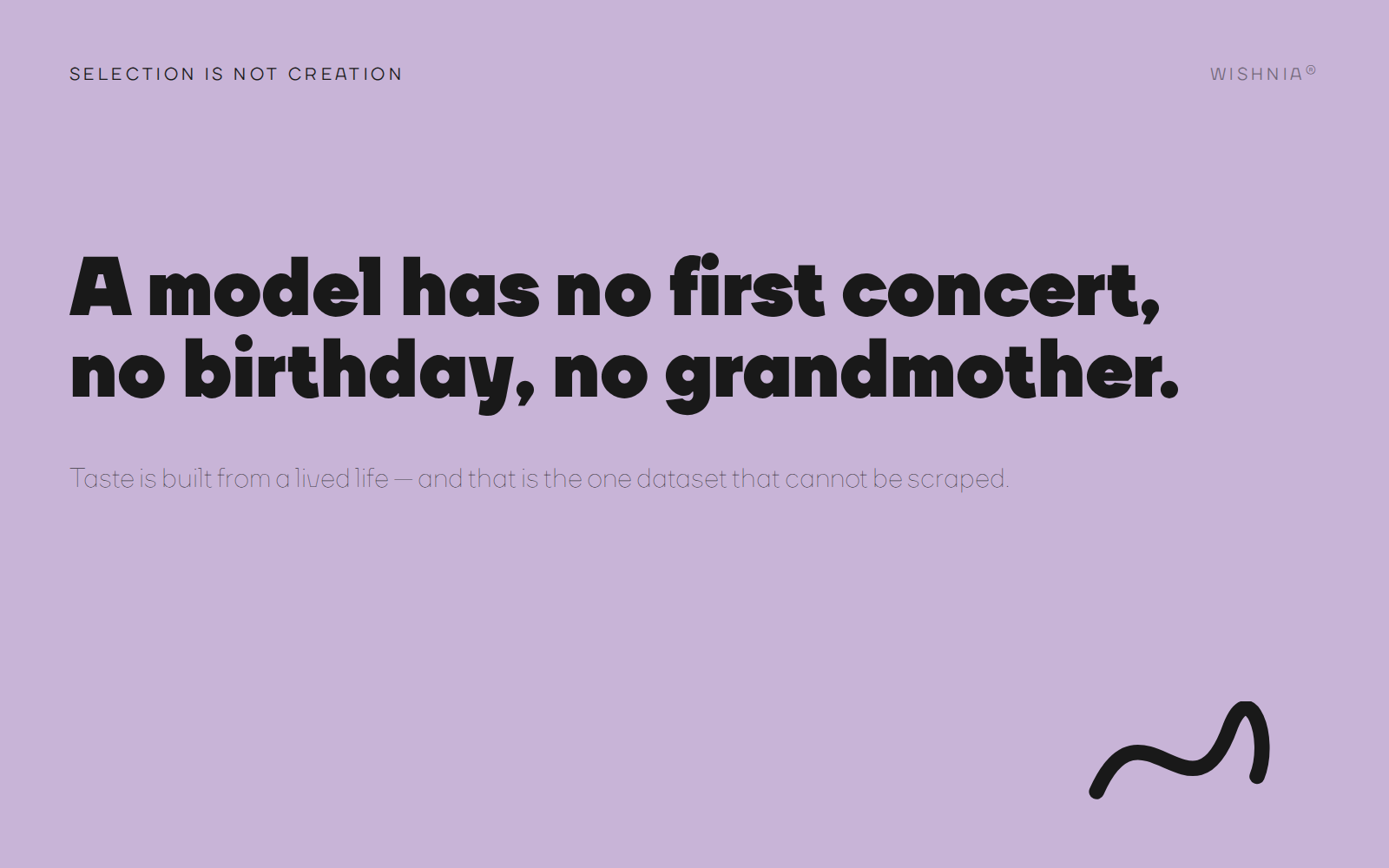
The usual objection is that taste is innate — you have it or you don't. The evidence points the other way. Taste behaves like a muscle: it grows with training and atrophies without it.Neuroscience gives this a concrete basis. We register aesthetic response faster than language — the signal that something is right arrives before the conscious thought that we like it. That response is biological, but its contents are learned. Every film you watch closely, every identity you take apart to see why it works, every reference you study rather than scroll past becomes a data point in an internal library. When a trained designer "just knows" which of forty options is the one, that instant judgment is the library working — thousands of absorbed decisions firing below the level of words.This is also why taste cannot be meaningfully digitized. You could, in principle, train a model on one designer's entire output. What you would get is a machine that imitates their past — and taste is not a record of past choices. It is a living instrument, updated by a specific life: the concerts, the failures, the cities, the grandmother's kitchen. A model has none of that. It has no first concert, no birthday, no grandmother. It has statistics. The difference shows up in exactly one place, and it happens to be the place that matters: freshness.So the practical program is unglamorous and completely available to anyone. Train the eye the way you would train at a gym — deliberately, regularly, with progressively harder material. Collect what works and interrogate why. The designers who seem to make magic are running a well-stocked selection engine in their heads. It was built, not born.
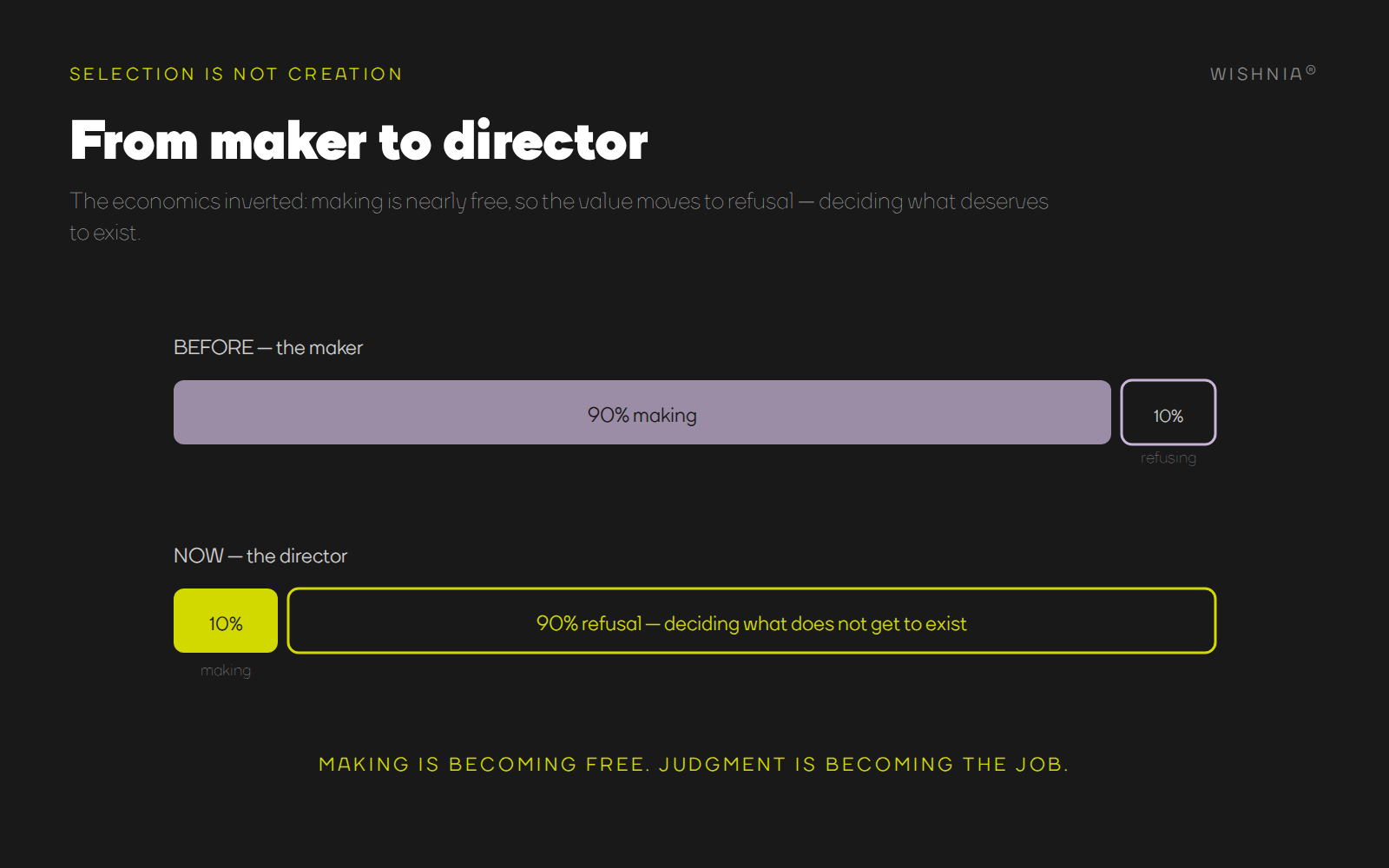
From maker to director
None of this means the craft dies. Craft always belongs to humans — but the shape of the job is changing, and pretending otherwise helps no one.The economics have inverted. Making used to be expensive, so a designer's week was mostly production: ninety percent making, ten percent rejecting. Now making is approaching free. The proportion flips: the machine produces volume, and the human's value concentrates in the other ninety percent — refusal. Deciding what does not get to exist. The designer becomes a director — call it editor, producer, curator; the job is the same: I decide what deserves to exist, and I answer for that decision with my taste.This is a more demanding role than it sounds, because refusal without standards is just mood. Direction only works under tension: you must know precisely what you are trying to achieve — what the brand means, who it speaks to, what feeling the work must produce — and then spend your energy bending the output toward that target, in whatever medium gets you there. If you are not actively bending probability toward an intention, the job is not done. Pressing the generate button again is not iteration. It is spectating.And an honest caveat belongs here: taste must serve the audience, not the ego. A designer working for clients is not an artist with one style; the client's success is the audience's success, and sometimes your own preferences are the wrong instrument for the job. Knowing when your taste doesn't fit is itself a function of taste.
The part that can't be automated
Code can be automated. Pixels can be automated. Logic and even fragments of strategy will get there. What resists automation is the reason any of us entered this profession: nobody became a designer to ship the average. We became designers to transfer emotion — to make a person feel something specific on the other side of the screen or the shelf.That transfer runs on everything a model doesn't have: a point of view, a biography, a set of convictions about what the world should look like. Which suggests a discipline that sounds almost contrarian now — sometimes, deliberately put the generator away. Work with your hands, on paper, in the material, precisely because it is slower. The friction is not an inefficiency to be optimized out. The friction is where the taste gets built — and taste, in the end, is the only asset in this industry that appreciates.
The tools will keep getting better at making things. Our job is to keep getting better at knowing which things are worth making. Those are not the same skill. The entire future of this profession lives in the difference.